A cobot is accepted on how fast it stops, not on whether it stops
Collaborative operation is a set of measured limits rather than a feature. The acceptance question is whether the cell stays inside those limits when a person walks into the space at production speed, and that is a test rather than a statement.
- Sheet
- 02 of 08
- Lane
- Safety
- Sections
- 10
- Points
- 12
- Issue
- Issue 24
- Filed
- 2026-11-24
What collaborative actually means
A collaborative robot is a robot whose design and installation allow it to work near people without a full physical separation. The permission comes from a combination of the robot's own limits and the cell's configuration, and the second part is usually the one that is under engineered.
The robot's limits are published: force, power, speed and stopping behaviour. The cell's configuration adds the tool, the workpiece, the fixture and the mounting, and each of those changes the effective limits at the point of contact.
So a collaborative robot carrying a sharp fixture is not a collaborative cell until the combination has been assessed. The robot's certificate describes the robot, and the acceptance describes the cell.
The practical framing is that collaboration is a property of the application rather than of the machine, and the acceptance test is the moment the property is either demonstrated or assumed.
The four modes and which one is being accepted
Most collaborative applications run in one of four modes: safety rated monitored stop, hand guiding, speed and separation monitoring, and power and force limiting. Each mode has its own measurement, and a cell that claims all four has usually specified none.
The monitored stop mode is accepted by proving that the stop happens within the distance the application assumes, at the speed the application assumes. The measurement is a distance and a time, not a reaction.
Speed and separation monitoring is accepted by proving that the protective separation distance is maintained as the operator approaches, which requires a measurement of the safety rated sensing field against the actual approach path.
Power and force limiting is accepted by measuring the contact force and pressure at the points where contact can occur, which is a different instrument and a different test from either of the other two.
The stopping distance is the number that matters
The stopping distance is the distance the tool travels between the triggering event and the completion of the stop. It is a property of the speed, the payload, the tool's inertia and the stopping category, and it is the figure that the separation distance is built from.
A cell whose separation distance was computed from a catalogue stopping figure and whose actual tool doubles the inertia has a separation distance that is too small. The error is invisible until a person walks into the space.
The measurement should be taken at the production speed and the production payload, on the real tool, and it should be repeated at the extremes of the payload range. A measurement at one condition describes one condition.
The result belongs in the acceptance record as a measured value with the condition stated, because the next person to modify the tool will need to know what the number was based on.
Approach speed and the human side
The human side of the assessment is an approach speed, and it is not a constant. A person walking toward the cell, a person reaching over a fixture and a person turning into the space have different speeds and different directions of travel.
The assessment should therefore describe the approach paths that are possible in the layout rather than a single assumed speed. A cell whose layout forces a single approach path has a simpler assessment than one that can be entered from four sides.
The detection field has to cover the paths that are actually possible, including the path over a bench or through a gap that the designer did not consider. A field that covers the front and not the side is a field that will be defeated by a person taking the shortest route.
The acceptance test should include an attempt to enter the space by the least convenient route, because that is the route the production team will find within a month.
The tool is the part that gets forgotten
The tool changes the mass, the inertia, the shape and the sharpness of the contact surface, and all four enter the safety assessment. A gripper with a soft pad has a different contact pressure from the same gripper with a machined jaw.
Tool changes after acceptance are the most common cause of a collaborative cell drifting outside its assessment. A new tool fitted by a technician who was told to improve the grip is a safety change that nobody recorded.
The control is a tool register with the mass, the centre of gravity, the envelope and the contact surface recorded for each tool, and a rule that a new entry requires a re assessment before production.
The register is a page, and the rule is a sentence in the maintenance procedure. Together they are the difference between a cell that stays compliant and one that was compliant on the day it was signed.
Guards, mats and the things that are not collaboration
A cell with a fence and an interlocked gate is not a collaborative cell, and calling it one does not change the assessment. The fence makes it a conventional cell with a conventional access control, and the collaborative argument is not needed.
The mixed case is the one that causes trouble: a collaborative robot inside a partial guard, with an opening that people use. The opening is either an access point with interlock or it is part of the collaborative space, and it cannot be both by accident.
The acceptance should state which parts of the space are collaborative and which are guarded, with the boundary marked on the layout. A layout without the boundary is a layout where the argument will happen after an incident.
The safety mat and the scanner are boundary devices and they belong to the guarded side. A mat that is relied on to make an opening safe is a mat whose failure mode has to be part of the assessment.
Documentation that survives an audit
The safety file for a collaborative cell has five parts: the risk assessment, the mode selection with the reason, the measured values, the tool register and the validation record.
The risk assessment should identify the tasks and the hazards per task rather than the hazards in general. A general list of hazards is a document that satisfies a template and does not help the person who has to decide whether a change is safe.
The measured values are the part that distinguishes a real file from a copied one. A file with stopping distances, forces and separation distances stated with conditions is a file that has been used. A file with the phrase as required by the standard is a file that has been assembled.
The validation record should say when the validation was repeated and what changed since the previous one. A validation that has never been repeated is a validation that describes a cell that no longer exists.
The production speed question
Collaborative cells are often specified at a reduced speed, and the reduction is a safety measure rather than a performance choice. The acceptance should state the maximum collaborative speed and the mechanism that enforces it.
The enforcement matters because a speed limit that is a program parameter can be changed by anyone with access to the program. A speed limit enforced by a safety rated input is a limit that requires a deliberate act to defeat.
The acceptance test should confirm the limit at the enforced value rather than at the programmed value, which means measuring the tool speed during a cycle rather than reading the parameter.
The measurement is a simple one and it answers the question that the safety assessment assumed. An unmeasured speed limit is a limit that exists in a document.
Training is part of the safety case
The operators, the maintenance staff and the people who clean around the cell all interact with it, and each group needs a different instruction. A single training session for all three is a session that teaches none of them.
The maintenance staff are the group that most often defeats a safety measure, because they are the group that has to work inside the space with the power on. Their instruction should cover the mode that permits it rather than a prohibition.
The training record belongs in the safety file, because an untrained operator is a residual risk that the assessment assumed was addressed. An assessment that assumes training without recording it is an assessment with an unclosed control.
The acceptance should include a demonstration that each group can perform its task under supervision, rather than a signature that each group attended.
The five questions to ask at acceptance
What is the stopping distance at production speed and payload, measured on the real tool. Which collaborative mode is being relied on and what proves the separation or the contact limit. Which parts of the space are collaborative and which are guarded. What enforces the collaborative speed limit. Who has been trained and on what.
Those five questions can be answered in an hour by an integrator who has done the work, and they cannot be answered at all by one who has assembled documents. The difference is visible in the first ten minutes of the meeting.
The answers belong in the acceptance record, written as measured values and named documents rather than as statements of compliance. A record that states compliance is a record that will be re argued at the first incident.
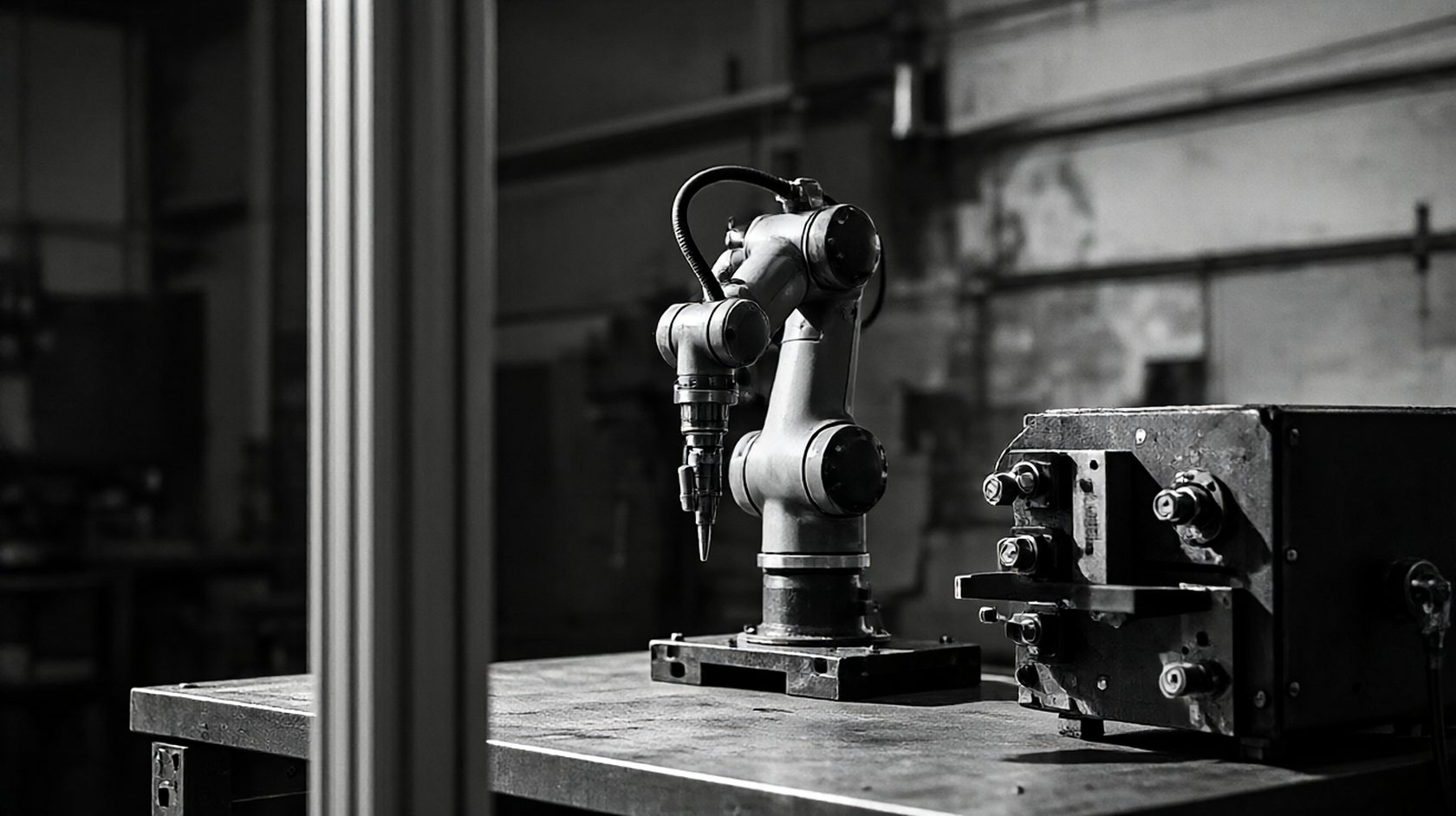
The cell this note describes in practice is a MIG welding cobot cell, where the tool, the arc and the fixture all sit inside the collaborative envelope and each of them changes the limits that were certified.
The application this note measures is a MIG welding cobot cell, where the tool, the arc and the fixture all sit inside the collaborative envelope and each of them changes the certified limits.
- Treat collaboration as a property of the application rather than of the robot.
- State which of the four collaborative modes the cell actually relies on.
- Measure stopping distance at production speed and payload on the real tool.
- Repeat the measurement at the extremes of the payload range.
- Describe the possible approach paths from the layout rather than assuming one speed.
- Test an entry by the least convenient route as part of acceptance.
- Keep a tool register with mass, centre of gravity, envelope and contact surface.
- Mark the boundary between collaborative space and guarded space on the layout.
- Confirm the collaborative speed limit at the enforced value rather than the parameter.
- Train operators, maintenance and cleaning staff separately and record it.
- Require a demonstration per group rather than an attendance signature.
- Answer the five acceptance questions as measured values and named documents.