A laser enclosure is accepted on its interlocks, not on its height
Enclosure height is the visible part of laser safety and it is the part that is easiest to get right. The part that fails audits is the interlock chain, because a chain is only as good as its weakest link and every link has a bypass.
- Sheet
- 04 of 08
- Lane
- Enclosure
- Sections
- 10
- Points
- 12
- Issue
- Issue 24
- Filed
- 2026-11-24
What the enclosure is for
A laser enclosure does two jobs: it contains the beam so that no person can be exposed to it, and it contains the process emissions so that the air in the working space stays inside its limits. Both jobs have acceptance criteria and only the first is usually tested.
Beam containment is a geometry question for the direct beam and an attenuation question for the windows and the openings. A panel that blocks the direct beam but passes a reflection through a gap is a panel that has been designed for the wrong beam path.
Emission containment is a ventilation question, and the criterion is the concentration in the working space rather than the flow at the duct. A duct that moves the specified volume and a space that still exceeds the limit is a space with a capture problem.
The acceptance should therefore have two sections, one for the beam and one for the air, and the second section is the one that gets omitted because it needs an instrument that the integrator may not carry.
The interlock chain and its performance level
An interlock chain is a set of devices and logic that removes the hazard when a guard is opened. Its reliability is expressed as a performance level or a category, and the level required depends on the risk assessment rather than on a preference.
A chain with a switch and a relay may reach a low level and a chain with two switches and a monitored safety controller reaches a higher one. The acceptance should state the level claimed and the architecture that supports it.
The architecture claim is what gets audited, because a chain that claims a high level and is built with a single switch is a chain whose claim is not supported. The audit reads the drawing and compares the architecture with the claim.
The chain includes the door switches, the light curtain or scanner, the emergency stop, the key switch and the reset. Each of them is a link, and the chain's level is the level of the weakest link rather than the average.
Testing every door and every panel
The interlock test should open every door and every removable panel, one at a time, and confirm that the laser is disabled and cannot be restarted until the guard is closed and the reset is operated separately.
The separate reset is the point that fails most often, because a reset that is the same action as the door closing is a reset that happens automatically. The requirement is that the restart is a deliberate act at a location from which the guard can be seen.
The test should also include the failure cases: a switch that is defeated with a jumper, a panel removed without opening the door, a door held closed while a person is inside. Each of those is a real scenario and each is a test.
The record should list every guard with its device type and its test result, because a record that says all interlocks tested is a record that cannot be checked against the layout.
Windows, viewing and attenuation
The viewing window is part of the enclosure and its attenuation is specified at the laser's wavelength and at the power density it will see. A window rated for a visible beam and used with an infrared source is a window that passes the hazard.
The attenuation figure should be read against the exposure limit rather than against a generic rating, and it should be read at the worst case distance from the process. A window that is adequate at a metre may not be adequate at a hand's width.
Window contamination is the mechanism that reduces attenuation over time, because a contaminated surface scatters and a damaged surface transmits. The acceptance should state a cleaning interval and a replacement criterion rather than only a specification.
The window is also the place where an operator will put a hand to steady a part, which means the distance assumption in the assessment has to be the actual working distance rather than a nominal one.
Bypass, maintenance mode and the honest exception
Every enclosure has a maintenance mode in which the interlocks are muted so that the cell can be run with a guard open. The mode is legitimate and the acceptance should describe it rather than pretend it does not exist.
The description needs three things: how the mode is entered, what it disables, and what prevents the mode from being left on after the maintenance is finished. A mode that is entered with a key and left on with a key is a mode that will be found on in the morning.
The mode should also have a restricted speed or a restricted power, because a muted interlock with full power is a muted interlock with no purpose. The restriction is the part that makes the mode defensible.
The acceptance record should state the mode's existence, its entry method, its restrictions and its exit check, because an auditor who finds an undocumented mode finds an uncontrolled one.
The extraction system is part of the enclosure
The extraction is what keeps the process emissions out of the working space, and its acceptance is a measurement of capture rather than a measurement of flow. A flow figure at the duct says that air is moving, and a capture test says that the air is going where the plume is.
The capture test is usually a smoke test: a plume is generated at the process point and the smoke is observed to enter the hood rather than escape. It is a qualitative test and it is far more informative than a duct flow reading.
The extraction also has a filter, and the filter's condition changes the capture. A filter that is loaded reduces the flow and the capture together, which means the capture test should be repeated at the filter's change interval rather than only when new.
The acceptance should state the capture method, the filter change criterion and the interval for repeating the test. An extraction system without a change criterion is a system whose performance degrades silently.
The materials question
The enclosure's inner surfaces see the process plume, and the surfaces' material decides whether the deposits are cleanable. A painted panel with a rough finish accumulates deposits that are hard to remove and that eventually become a fire load.
The acceptance should state the surface finish and the cleaning method, because the two are linked. A surface specified as smooth and cleaned with an abrasive is a surface that becomes rough within a year.
The enclosure also has a fire question, because the plume can ignite the deposits. The acceptance should state the detection and the suppression, or the absence of both with the reason.
Those items are not usually in an enclosure specification and they are the ones that an insurer will ask about after a small fire. A record that answers them is a record that shortens the conversation.
Signage, training and the boundary
The enclosure's boundary should be marked with the hazard class and the required eye protection, and the marking should be at the point of access rather than on the machine's nameplate. A warning at the door is read; a warning in a manual is filed.
The training should cover the three groups separately: the operators who work at the window, the maintenance staff who enter the mode, and the cleaners who open the guards. Each group's instruction is about a different boundary.
The training record belongs with the enclosure's file, because the assessment assumes trained people and an untrained person is a control that has not been applied.
The boundary also has a visitor case, which is the one that is least documented. A visitor who is walked through the cell during a demonstration is a person inside the boundary, and the escort rule is part of the acceptance.
The audit that follows
An audit of a laser enclosure reads four things: the risk assessment, the interlock architecture drawing, the test record and the maintenance log. The four have to agree, and the disagreement is what the audit reports.
The most common finding is an architecture that has been modified on site without the drawing being updated. The second is a test record that covers the doors and not the panels. The third is a maintenance mode with no exit check.
The findings are cheap to prevent at acceptance because the documents are being written anyway. They are expensive to correct afterwards because the correction requires an outage and a re validation.
The acceptance pack for the enclosure should therefore be the audit pack. A pack that answers the four documents has been built for the audit rather than for the invoice.
What the enclosure described here looks like
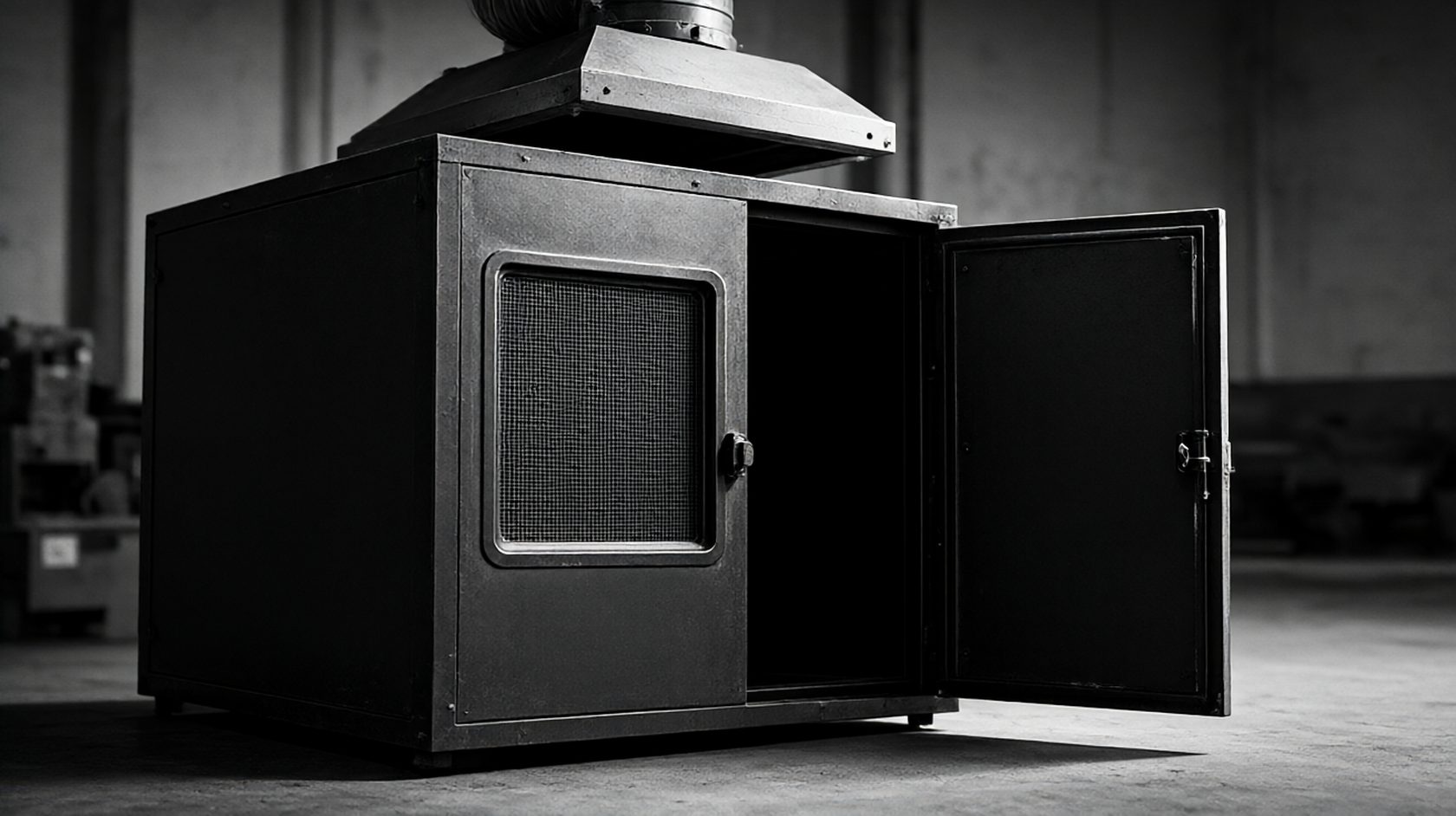
The enclosure this note is written against is a laser protective enclosure built around a welding cell, and its acceptance has the two sections and the four documents described above.
The geometry is a frame with panels, a viewing window, a door with an interlocked switch and an extraction hood over the process point. That is a conventional layout and the conventional layout is where the audit findings cluster, because the conventional layout is the one that gets copied without the assessment.
The acceptance items specific to that layout are the window's attenuation at the working distance, the door's reset separation, the panel's interlock coverage and the hood's capture at the filter change interval.
Four items, each with a measurement or an observation, and together they are the difference between an enclosure that passes an audit and one that passes an invoice.
The enclosure this note is written against is a laser protective enclosure built around a welding cell, where the window, the door and the hood each carry their own acceptance item.
- Accept the enclosure on both beam containment and emission containment.
- State the interlock performance level claimed and the architecture that supports it.
- Test every door and every removable panel one at a time.
- Confirm the restart is a separate deliberate act from a position that sees the guard.
- Test the defeat cases: jumper, panel without door, door held closed.
- Read window attenuation at the laser wavelength and at the working distance.
- Set a window cleaning interval and a replacement criterion.
- Document the maintenance mode with entry method, restrictions and exit check.
- Restrict speed or power in the maintenance mode.
- Run a smoke capture test rather than relying on duct flow.
- Repeat the capture test at the filter change interval and state the criterion.
- Mark the hazard class at the point of access and train the three groups separately.