Cycle time is proved on the slowest part, not on the average one
A cycle time quoted as an average describes a cell that has already been running for a year. The number that decides whether the cell pays for itself is the one on the part that fights back, and that part is in every batch.
- Sheet
- 05 of 08
- Lane
- Cycle
- Sections
- 09
- Points
- 12
- Issue
- Issue 24
- Filed
- 2026-11-24
What cycle time counts
Cycle time is the interval between two consecutive good parts leaving the cell, measured from the moment the first part enters to the moment the second part is ready to enter. It includes the load, the clamp, the process, the unload and the transfer, and it excludes nothing.
The definition has to be written because most disagreements about cycle time are disagreements about scope. A figure that excludes the load and the unload is a figure for the process alone, and it will be about half of the figure the buyer needs.
The cell's cycle time is also not the line's cycle time. A cell that produces a part every forty seconds into a buffer that the next station drains every sixty is a cell that the line runs at sixty.
So the acceptance should state three numbers: the cell's cycle time, the line's takt and the buffer between them. A cell accepted against a takt without a buffer is a cell accepted against an assumption.
Why the slowest part exists
Every batch has parts that take longer, and the reasons are structural rather than accidental. A seam that needs a longer lead in, a joint that needs a tack, a part that needs a different fixture position, a seam that needs a second pass.
The distribution is therefore bimodal in many cells: a large group at the nominal time and a smaller group at a longer time. An average over the two groups describes a part that does not exist.
The correct figure for planning is the percentile that the line can tolerate, and the acceptance should state it. A cell accepted at the median will miss its output on any day with a normal mix.
The practical statement is that the cell meets its cycle time on the ninety-fifth percentile part, or the cell meets it on the nominal part and the batch mix is limited. Both are legitimate and only one of them is usually written.
The seam is the process variable
For a longitudinal seam the process time is set by the weld length and the welding speed, and the welding speed is set by the penetration required and the power available. Those three are linked and the linkage is the reason a faster speed is not simply a parameter change.
The seam's gap and mismatch also set the speed, because a gap that the beam can bridge at one speed cannot be bridged at a higher one. A cell that runs faster on tight seams and slower on loose ones is a cell whose cycle time depends on the upstream cut quality.
The acceptance should therefore measure the seam's gap and mismatch on the parts used for the test, and state them. A cycle time proved on parts with a nominal gap is a cycle time that assumes the upstream process.
The upstream assumption is the one that breaks first in production, because the shear or the laser cut wears and the gap grows. The cell's cycle time then grows with it, and nobody connects the two.
Power, speed and the cooling between passes
The laser's power is a continuous rating at a duty cycle, and a seam that needs a high power for a long time runs into the duty cycle before it runs into the speed. The limit appears as a derating or a fault, and it appears on the longest seam rather than the average one.
The cooling between passes is a real constraint for a cell that runs several seams on one part. The part has to cool enough to hold its shape before the next seam, and the cooling time is part of the cycle even though nothing is happening.
Those two limits mean the cycle time curve is not linear in the seam length: short seams are limited by handling and long seams are limited by power and cooling. A single cycle time figure for a family of parts hides the shape of that curve.
The acceptance should therefore test the longest seam in the family as well as the nominal one, because the longest seam is where the two limits appear.
The measurement method
The measurement is a stopwatch on a defined start and end event, repeated over a run of consecutive parts, with each part's time recorded rather than only the total. A total divided by the count is an average and the average is the number that hid the problem.
The run should be long enough to include at least one of each part type in the mix, which for a three variant family means at least three parts and practically means fifteen.
The measurement should be taken with the real operator and the real part supply, because both of those are part of the cycle and both are different during a demonstration.
The instrument can be a stopwatch and the record should state that it was one, because a cycle time quoted to a tenth of a second from a hand timing is a number with more digits than accuracy.
When the cell is not the bottleneck
A cell that is faster than the station downstream is a cell whose cycle time does not matter, and the acceptance should say so rather than proving a number that will not be used.
The relevant figure in that case is the cell's capacity headroom, which is the difference between its cycle time and the takt expressed as a percentage. A cell at eighty percent of the takt is a cell with twenty percent headroom and that is the number the planner needs.
The headroom is also what absorbs the slowest parts, which is why a cell with headroom can be accepted on the nominal part and a cell without headroom cannot.
The acceptance should state which case applies, because the two cases need different evidence and the same test does not serve both.
Startup, first part and steady state
The first part of a shift is slower than the tenth, and the reason is thermal rather than mechanical: the fixture, the part and the machine all reach a steady temperature after a few cycles.
A cell accepted on a cold start will meet its figure for the first hour and miss it for the rest of the shift, or the reverse depending on which way the drift goes. The direction depends on whether the process expands or contracts the geometry.
The acceptance should therefore run after a warm up of the stated number of parts, and the warm up count belongs in the record. A test that starts cold is a test of a different cell.
The warm up also matters for the first article: a first article taken cold is a first article that describes the cold state, and the program offset will then be wrong for the shift.
The record and the argument it prevents
The record should carry each part's time, the part type, the seam length, the gap and mismatch, the power and the speed, the operator and the warm up count. Eight fields and one table.
That table answers the question that arrives six months later, which is why the cell is slower now than it was at acceptance. The answer is usually a change in one of the eight, and the table shows which.
A record without those fields answers the question with an opinion, and an opinion about cycle time is the start of a commercial argument rather than a maintenance action.
The table should be delivered as part of the acceptance pack and kept with the cell's file, because it is the baseline against which every later measurement is compared.
The number to put in the contract
The contract should carry a cycle time with four qualifiers: the part, the supply condition, the percentile and the warm up. Four qualifiers turn a number into a specification.
The contract should also carry the remedy, which is what happens when the figure is missed. A remedy of a re test is a remedy that produces another measurement. A remedy of a rate adjustment is a remedy that produces a decision.
The remedy should be scaled to the shortfall rather than binary, because a cell that misses by two percent and one that misses by twenty are different problems and a binary remedy treats them the same.
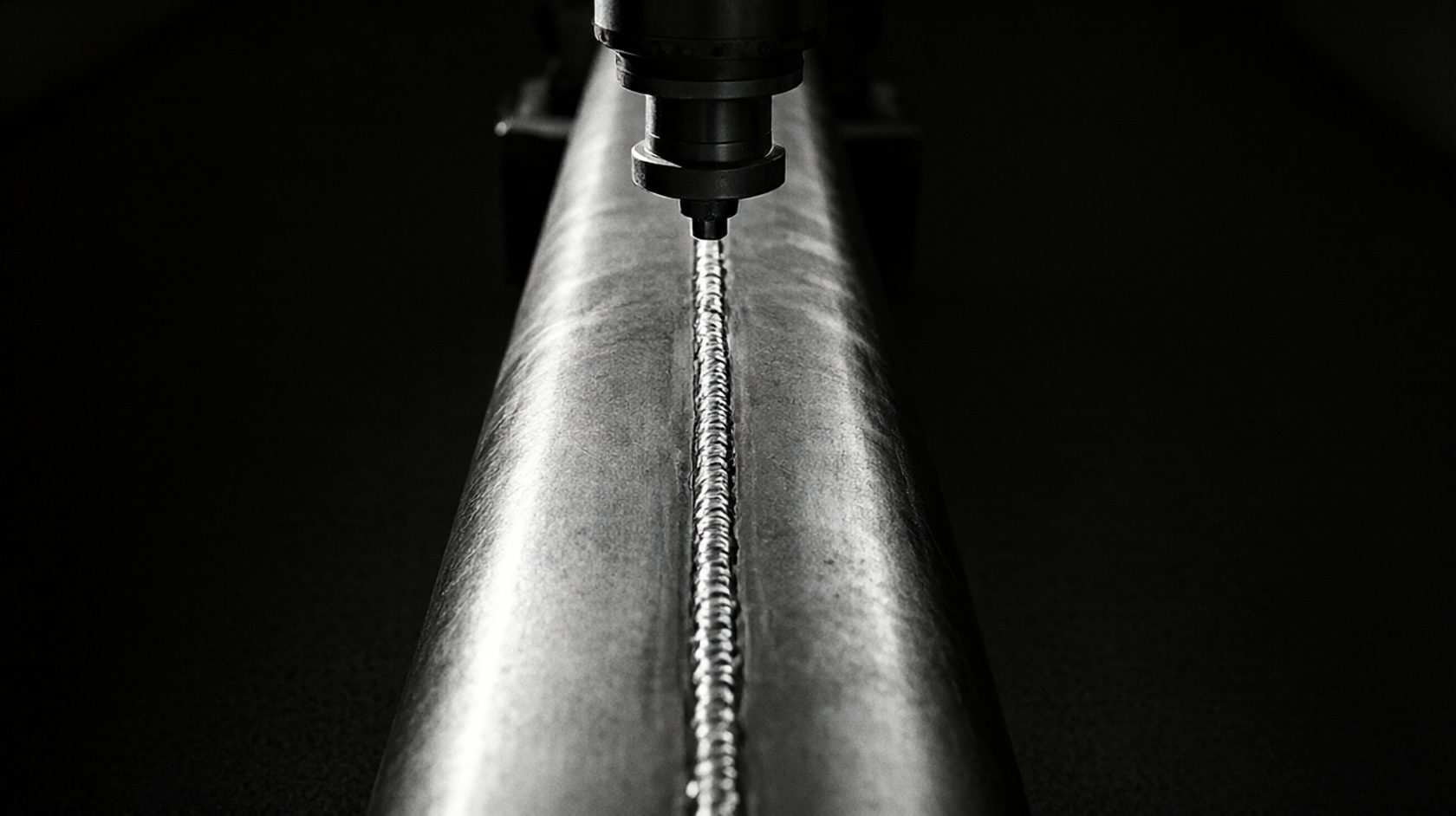
The cell described in this note is a three kilowatt longitudinal seam laser welder, where the seam length, the gap and the power limit interact in exactly the way described, and the longest seam in the family is where the cycle time is decided.
The machine this arithmetic describes is a three kilowatt longitudinal seam laser welder, where the longest seam in the family is the one that sets the cycle time.
- Define cycle time from part entry to part entry and write the scope down.
- State the cell cycle time, the line takt and the buffer between them separately.
- Accept on a stated percentile part rather than on the average.
- Measure the seam gap and mismatch on the parts used for the test.
- Test the longest seam in the family as well as the nominal one.
- Record each part's time rather than the total divided by the count.
- Run with the real operator and the real part supply.
- State the warm up count and test after it.
- State whether the cell is the bottleneck; if not, report headroom instead.
- Carry part type, seam length, gap, power, speed and operator in the record.
- Put the part, supply condition, percentile and warm up in the contract figure.
- Scale the remedy to the shortfall rather than making it binary.